



Espresso Accessories for Beginners: What Fits Your Machine and What You Can Skip
Essential espresso accessories for beginners: match your machine, avoid unnecessary tools, and get the best brew at home.


Published: October 24, 2026
Affiliate disclosure: As an Amazon Associate I earn from qualifying purchases. Product links on this page go to Amazon, and buying through them supports this guide at no extra cost to you.
How this guide was put together: picks are based on published specs, manufacturer information and patterns in buyer reviews. We have not tested these products hands on.
Buying for someone who already has an espresso machine is tricky. They have the big item, and many accessories only fit certain machines. A tamper or a puck tool is useless to someone whose machine grinds and tamps for them, and a milk jug is no help without a steam wand. So this guide is organised by one question: what does their setup already have?
Gifts that fit any machine: cups, glasses, a bean canister and a scale. Safe picks if you know nothing about their setup.
Gifts for manual machine owners: a puck prep tool, for people who put coffee into a handle (the portafilter) themselves.
Gifts for machines with a weak steam wand, no wand at all, or a bean to cup machine: a standalone milk frother.
The picks run across budget, mid range and premium, so there is something at each level.
Look for the model name. It is usually printed on the front or top of the machine. Snap a photo next time you visit, or look for it in the background of a coffee photo they have shared.
Work out the type. If they lock a handle with a basket into the machine, it is a manual (portafilter) machine. If they press a button and the machine grinds, tamps and brews by itself, it is a bean to cup machine.
Check for a steam wand. It is the thin metal pipe on the side used to heat milk. If there is none, or they complain their milk never gets foamy, a frother is a strong gift.
Portafilter size only matters for tools sized to the basket, such as tampers and dosing funnels. Once you have the model name, the manual will list it. None of the picks below needs a portafilter size, which is why they make safer gifts.
Roasted coffee loses flavour once it meets oxygen, and light and heat speed that up. Beans left in an open bag or a clear jar on a sunny counter go flat sooner. A canister that pushes the air out and keeps light off the beans helps a bag taste fresh for longer, which is a gift they will notice every morning.
As an Amazon Associate I earn from qualifying purchases. Product links below go to Amazon.
What it is: four small ceramic espresso cups with saucers, spoons and a metal stand to keep them together on the counter.
Who it suits: anyone who drinks straight espresso or small drinks such as a macchiato or cortado. Cups fit every machine type, so you cannot get this one wrong.
Worth knowing: the maker lists each cup as 3 oz, about 2.6 inches across and 2.3 inches tall, and the listing comes in several colours and sizes, so check you have the 3 oz set of 4 you want.
What it is: two handmade borosilicate glass mugs with a double wall, so the drink looks like it floats and the outside stays cooler to hold.
Who it suits: anyone who enjoys seeing the layers of an espresso or a small milk drink. The listing describes them as 5.4 oz, which leaves room for a double shot or a small cappuccino.
Worth knowing: the listing says they are dishwasher and microwave safe and arrive in a gift box. Thin double wall glass can crack if knocked, so they suit a careful owner.
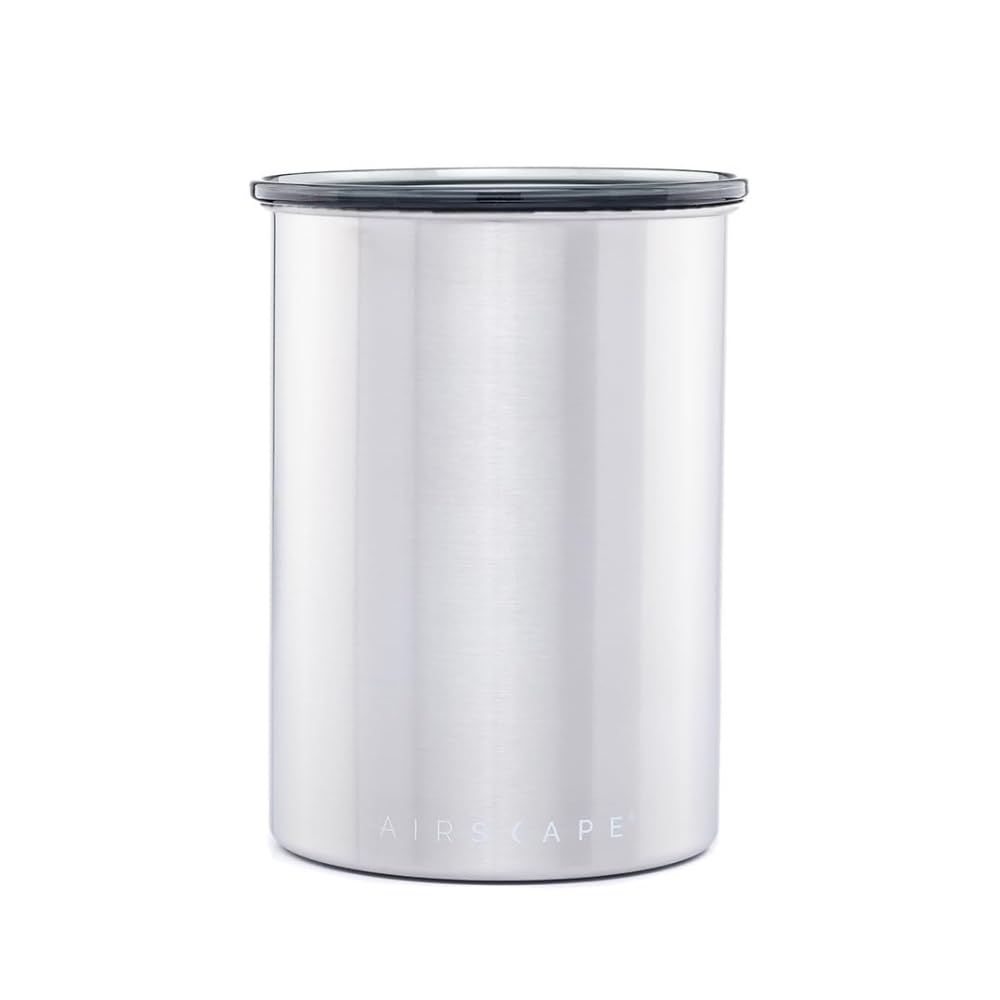
What it is: a steel canister with an inner plunger lid that you press down onto the beans to push excess air out, then lock.
Who it suits: anyone who buys whole beans or ground coffee in bags. It works with every machine type, including bean to cup machines, whose owners still need somewhere to keep the beans.
Worth knowing: the maker says the medium size holds about 1 lb (500 g) of whole beans. The maker also notes the standard inner lid does not release the gas fresh coffee gives off, though some escapes each time it is opened. Keep it away from the oven and sunny windows.
What it is: a compact scale that reads to 0.1 g with a built in shot timer, a glass top and a rechargeable battery.
Who it suits: owners of manual machines who want to weigh coffee in and espresso out, which is the simplest way to make shots more consistent. It also helps with pour over.
Who can skip it: bean to cup owners, since the machine doses for them.
Worth knowing: the maker lists it at about 4.1 by 4.1 inches and under an inch tall, small enough for many drip trays, but it is still worth checking there is room for a cup on top under the spout.
What it is: a puck prep tool with fine needles that you stir through the ground coffee in the basket to break up clumps before tamping. The needles retract into the body when not in use.
Who it suits: owners of manual machines who use fresh ground coffee and non pressurised baskets, where clumps can lead to uneven shots. It does not depend on basket size.
Who can skip it: bean to cup owners (there is no basket to stir), and anyone using pre ground coffee with pressurised (dual wall) baskets, where it makes little difference.
Worth knowing: the listing says it comes with a stand, a magnetic mount for the side of the machine or a wall, and two sets of spare needles.
What it is: a standalone jug that heats and froths milk at the press of a button, with a temperature dial and separate discs for latte and cappuccino style foam.
Who it suits: bean to cup owners without an automatic milk system, owners of compact machines with a basic steam wand, and anyone who finds steaming milk fiddly. It also makes hot chocolate and chai.
Who can skip it: people happy with their steam wand, or who only drink straight espresso.
Worth knowing: the maker says the jug can go in the dishwasher and the unit switches itself off once the milk reaches temperature. This listing is the US 110 to 120 volt model.
You know nothing about their machine: cups, glasses or the canister. They fit everyone.
Manual machine, fresh ground beans: the scale and the WDT tool make a good pair.
Bean to cup machine, or a weak steam wand: the milk frother, plus a canister for the beans.
Buying a tamper or dosing funnel without knowing the portafilter size.
Giving puck prep tools to a bean to cup owner, whose machine has no basket to prepare.
Buying a milk jug for someone whose machine has no steam wand.
Read our beginner guide first: Best Espresso Machine for Beginners: Three Types, Plainly Explained
Sources: listing details on the Amazon product pages checked 24 Oct 2026; Planetary Design product notes on the Airscape listing (capacity, inner lid, why oxygen affects coffee).
Essential espresso accessories for beginners: match your machine, avoid unnecessary tools, and get the best brew at home.
Best espresso machine for beginners: a compact manual machine, one with a built in grinder, or bean to cup. Who each suits, what specs mean, who should skip.